Cinema specialist Die Zwei brings physics and fantasy into one design language in this basement project. HiddenWires explores.
Translating as ‘the two’, Die Zwei is a small German company with big impact. Stefan Becker and Thorsten Köhler oversee its in-house speaker production and integrated design, their synchronisation on show in Flotopia; a CEDIA award-winning cinema with a built-in bar and pitted layout. Located in the Austrian Alps, the project is a reminder of the duo’s international reach.
“I love extraordinary aesthetics,” explains Köhler, co-founder and managing partner. “Cinema is too often limited by shoebox design. But as a medium for storytelling, it deserves much more artistic expression. The room is just as important as the technology; often you need a small adjustment either side to get a better outcome.”
The client worked with Köhler on décor, rather than an interior designer, and wanted the cinema to fit into his whole-home renovation. Inspired by Gatsby-era glamour, LED strips and wall fixtures illuminate the room in exotic and dulcet tones.
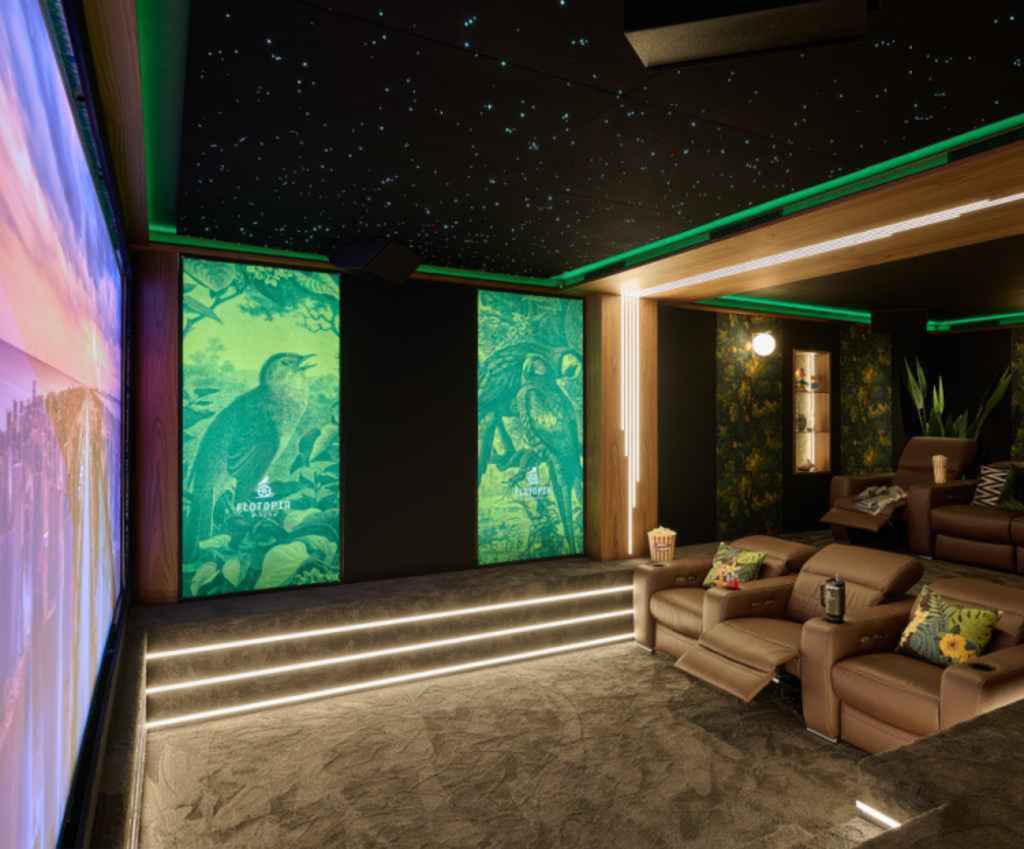
Perfectly imperfect
Having previously installed a sound system and CRT projector in the space, the client sought next-level performance with a professional integrator on board. And with a room size measuring less than 20sqm, Die Zwei seized the challenge.
“We expanded the cinema by incorporating an adjacent room, faciliating a bar area right at the front of the room,” recounts Köhler. “This expansion wasn’t planned; it emerged naturally as the project evolved. To elevate the comfort of the basement room to the high standards of the rest of the house, we added a new electrical system, ventilation and floor heating.
“Likewise, the basement’s low ceiling prompted us to dig down to gain extra height for the Atmos speakers above the first row. Normally we would elevate the second row on a platform to support acoustics, but it was no longer necessary due to the reconfigured layout.”
The room’s dimensions literally immerse viewers, then, in large-scale entertainment; the “bigger than intended” screen emerged from Köhler’s experiments with virtual reality. “I started with a four-metre-wide screen and then the client asked to go bigger,” he says. “I explored that with the help of a CAD system for planning and renderings.
“After modelling the room, I used VR glasses to verify the calculated performance in seats on the outer edge, as that's usually where limited viewing or listening occurs.”

Sound and space
The 11.1(8).4 system, supported by eight subwoofers in a 4+4 WaveForming configuration, includes three screen channels along with wides, sides, rears and four overheads. The Beckersounds models, manufactured specifically for the two seating rows, are angled towards reference listening position.
“We plan most of our projects around Waveforming,” explains Köhler. “The double bass array concept, which we've used in our projects for more than a decade now, was invented in Germany. With this principle at the heart of our work, we know low frequency reproduction will be even.”
He’s referring to the technology that controls bass wave movement through the room. Patented by Trinnov, it uses multiple subwoofers and precise timing to push bass in one direction without it bouncing back.
“That's a real issue with normal setups,” Köhler adds. “If you play bass and walk around the room, you'll notice it changes. There are spots where it's exaggerated, while dwindling to nothing elsewhere. With subwoofers on the front wall and back, we can achieve active absorption.”
The Trinnov Altitude 32-channel processor measures the room, predicts how bass waves will move, then controls the front and rear subwoofers. The result is clear onward travel, before the bass is electronically absorbed at the back.
The speakers in the 2D- and 3D-plane are all actively pre-equalised before Trinnov Optimiser tuning and crossed over to the 4+4 WaveForming subwoofer configuration.
Designed by Becker, these models include top front/rear and left/right units purpose-built for the room itself. “We did cut into the back of the left and right front speakers to reduce the space they took up when angled toards the seating position,” explains Köhler. “Manufacturing your own speakers is always a huge advantage.”
After enjoying the dynamics and precise bass reproduction of his cinema setup, the client was keen to use it for music listening. For this purpose, the Altitude processor acts as a Roon endpoint, receiving audio streams from a Roon Core and playing music from NAS streaming services.
Imagery and visuals
Thoughtful application remained crucial for image as well as sound, hinging on high-lumen projection. “We use top-end projectors, in this case the Sony VPL-GTZ380, to achieve quality from a professional rather than consumer perspective,” explains Köhler. “We don’t want to increase the overall brightness of the image, as that would make it uncomfortably bright. Instead, brightness remains at SDR levels while additional headroom is reserved for highlights.”
The required adjustment within the projector and the video processor are all automatically handled in the background.
Köhler also points out the need for high laser power to support bright projectors: “That means a lot of heat and increased ventilation, translating into unwanted noise. For that reason, we prefer to place the projector outside the cinema room, which was easily possible in this case."
The system includes a MadVR Envy video processor that detects aspect ratio and adjusts screen masking accordingly. The integrator avoided fully automated masking in anticipation of constant movement, and the frustration this is likely to cause end users.
“What you don't want is technology controlling you,” says Köhler. “But then we also don’t want to oversimplify the system, as that would prevent getting everything out of it. Sometimes you just need to adjust it a little with manual control.”
A Crestron dealer, Die Zwei programmes the system’s Crestron controls through remote VPN access. The duo specified a handheld remote which sits under accent lighting and a large wall touchpanel in front of the cinema room, alongside the amplification and processing technologies. It’s clear the system design leans on visual form, from statement racking to custom backlit frames.
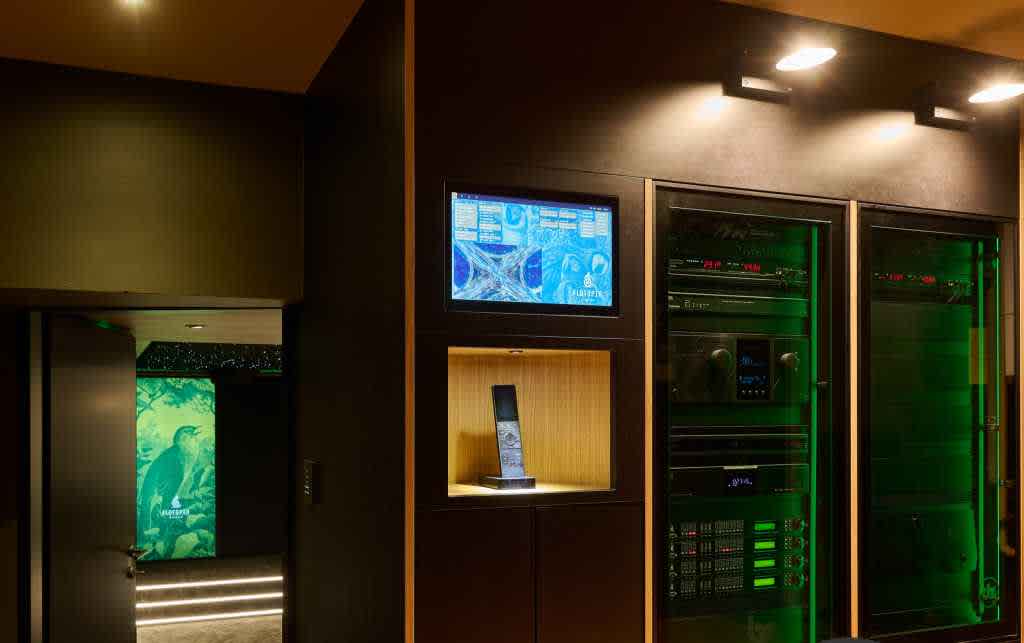
“I propose technology presentation to the client as it can add drama, especially with lighting,” says Köhler. “There's something appealing about making that investment tangible so the client can see it, touch it, try to understand it.”
Drawing on Köhler’s IT background, the team resolve most issues remotely and visit only when hardware is damaged. A monitoring system checks status to identify potential issues. “Sometimes we’re notified even before the client notices something's wrong,” he says. “What I love about this project is how it let us apply our full engineering expertise, from designing the room itself to managing long-term sound wave behaviour and control systems.”
Flotopia ultimately proves how awkward constraints can spark unusually imaginative design thinking; its room layout is not only part of the acoustic toolkit, but harnesses technology as an artistic medium. As a result, the space transforms into a physical expression of the client’s inner world - an environment where greens, whites and a swathe of stars pack scale snugly into the home.
All image credits to Marcel Hagen, Studio 22
Tech-Spec
Apple TV 4K
ARLED custom projection screen with electronic masking system, with 17 custom and two backlight DMX-controlled frames
Beckersounds a200-9, -16 and -8 speaker amplifiers (250W per channel) with four a1500-2 subwoofer amplifiers (1500W per channel), three b500 LCR speakers, eight b250 front wides/surrounds, four b200 height channels and eight b1000 subwoofers
Crestron CP4 control processor with DGE-100 wall touchpanel controller, TSR-310 handheld remote, HZ2-KPCN wall keypad and DIN-8W8-I eight-port relay switch
Domotz Box remote monitoring
DT-Screens DT-PHG-2 porthole glass
Gude Expert Power Control EPC-8221 230V switched PDU (2 circuits) with temperature and humidity sensors
MadVR Labs Envy video processor
Middle Atlantic cooling fans with 12V trigger outlet by Vocomo, main cinema SRSR-4X-30 and amplification -24 racking
Mikka MK173XAML 17-inch wall touchpanel
Roon Nucleus music server
Sony GTZ-380 4K SXRD laser projector
Sony UBP-X1100ES UHD disc player
StarCeiling custom ceiling with DMX control
Trinnov 4K-to-1080p Downscaler for wall touchpanel preview and Altitude 32-channel configuration audio processor
Xilica DSP-4080 audio processors
Zidoo UHD5000 media player