After developing the largest subwoofers in the world, Geoffrey Heinzel explains how wave theory and room acoustics influence the mysterious power of infrasonic bass.
Physicist Niels Bohr tells a young Oppenheimer in Christopher Nolan’s 2023 blockbuster that mathematics is like sheet music: “The important thing isn’t whether you can read it. It’s whether you can hear it. Can you hear the music?” It’s a profound moment when science and storytelling converge; and it’s one that comes to mind in conversation with Geoffrey Heinzel, founder of ASCENDO Immersive Audio and a leading pioneer of infrasonic bass for residential environments.
Heinzel himself might be seen as something of a scientist. Credited with developing the 24, 32, 50 and 80-inch subwoofers that paved the way for the largest models ever built, he remains at the centre of a sonic revolution following the debut of ASCENDO’s 64 and 100-inch subwoofers at CEDIA Expo 2025.
“We bring the firepower,” he smiles. “The idea for bigger subwoofers was born after CEDIA 2016. We brought 24-inch subwoofers to the show, but the room wasn’t physically rigid enough to contain the bass – it was leaking into the exhibition hall. From that point onwards, I focused on applied physics while I tested the largest commercially available subwoofers at the time.”
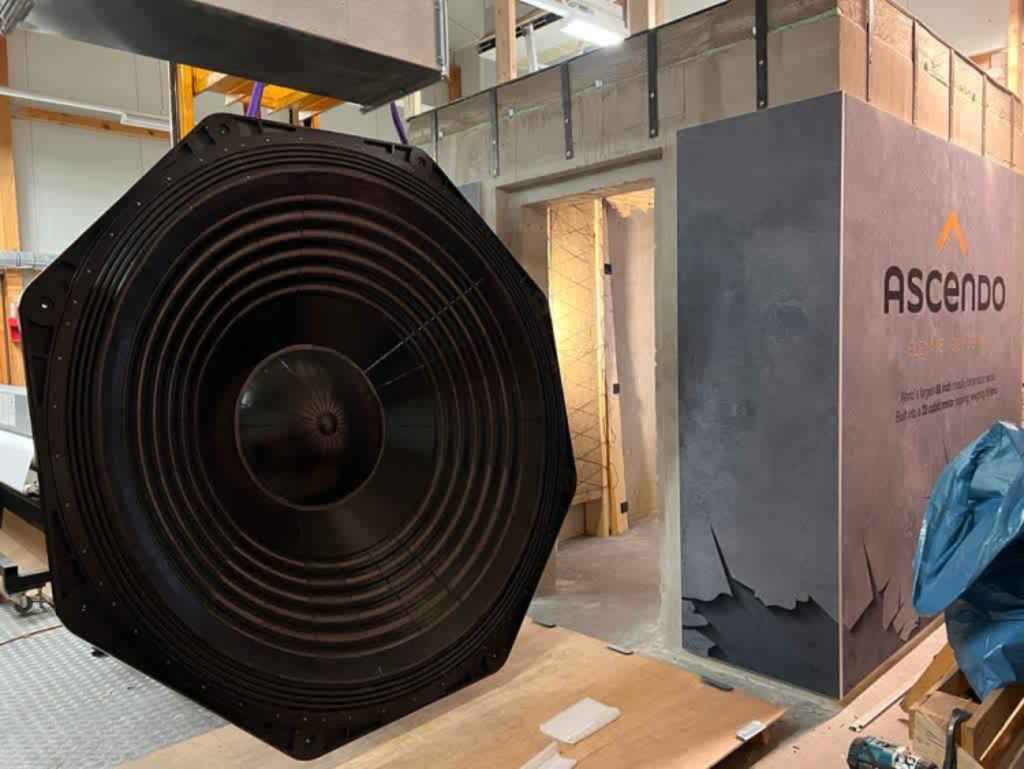
Seeing the scale: THE100, pre-install
What is infrasonic bass?
Infrasonic bass is defined as a single-digit frequency below the threshold of human audible perception. Its vibrations could be described as elemental, apocalyptic, as old as time itself; they have been recorded in everything from natural phenomena to man-made explosions. Heinzel says that in audio, especially when dealing with low frequencies and bass, it's crucial to work with physics rather than against it.
“We bring the firepower."
“I always wanted to understand how bass, in all its enormity, could be reproduced with detail and clarity,” he explains. “Large cone woofers were known for sloppy bass, the result of motors that weren’t strong enough to drive those cones. So we developed motors capable of accelerating a huge cone with precision and control. That’s how we moved beyond the 24-inch subwoofer at ASCENDO.”
Bass behaves differently in enclosed spaces than it does in large, open environments like stadiums. In a room, the air volume forms a contained system, like the air inside a tyre, and the subwoofer must move that air to create pressure changes and reproduce deep bass. “In-ear headphones offer a good analogy,” Heinzel adds. “Due to high pressure, they can achieve very low frequencies even though the channel inside your ear is very short.”
Larger, more powerful subwoofers can compress air more easily and quickly to create greater extension.
The need for scale
“As I explored the concept of large subwoofers, I started experimenting with amplifiers already on the market,” says Heinzel. “Eventually, we had to build our own because there were no off-the-shelf amps that could handle it. It’s always a combination: a speaker driven by an amplifier. And electronics are no longer linear at ultra-low frequencies.”
The company’s 32-inch subwoofer design broke new territory with its reproduction of frequencies down in the single digits. But size alone wasn’t enough. Stroke, or cone travel, had to be equally extreme.
“In a room, we need to define both the cone area and the stroke, which is the amount of air the subwoofer can move,” Heinzel explains. “Our subwoofers provide two inches of linear travel in each direction, four inches peak-to-peak. To double the perceived loudness, you need four times the air displacement.”
Human hearing comes sharply into focus here; the Fletcher–Munson curve, or equal-loudness contour, shows our ears are less sensitive to low frequencies. To perceive them as equally loud, they must be reproduced at much higher SPLs. “Because it’s such a steep curve, you can never have enough cone area or air displacement to reproduce those ultra-low frequencies in a natural way,” adds Heinzel.
Big sound at home
This physically translates directly into size: “It should be painfully obvious why 100-inch subwoofers are necessary,” he says. “The more air you can displace without delay, the better the bass.”
But installing such monstrous units in residential environments like a home cinema, for example, is no simple feat. Integrators must consider structural support, in-situ construction and room calibration at every stage. “We must carefully assess the available space, because most of our clients live in dense areas,” Heinzel notes. “Integrators or clients often have preferences for surround processors, and we generally use Trinnov or StormAudio for that purpose.”
“The more air you can displace without delay, the better the bass.”
ASCENDO products are often used in installations where Trinnov and Storm Audio are present, as they all perform at a similar level of extreme high performance. The relationship even extends into product development; for example, THE28 SUB SQUARED was the result of one conversation at ISE with Trinnov CEO Arnaud Laborie, who wanted to enhance bass performance.
“Every structure has its own resonance frequency, whether a wall is built from gypsum in the US or concrete in Europe,” Heinzel says. “The lower we go, the more those materials begin to resonate. We monitor SPLs carefully and rarely reach the system’s limits, because that would destroy your ears.” CEDIA continues to define these standards for audio in home theatre, having just released a white paper on Reference Audio Level and SPL Capabilities. In keeping with Heinzel’s point about scale, it points out that sound energy in larger spaces “differs markedly from that in smaller rooms, where reflections arrive more rapidly, with greater intensity, and with minimal spectral attenuation”. Heinzel is part of the CEDIA Standards body to shape standards like RP22, RP10 and RP32.
While rumbling infrasonics have long been the domain of theme parks and rock concerts, ASCENDO’s goal is fundamentally different. “Professional systems were built to deliver effects that are felt rather than heard,” he says. “For us, the focus is on transition and speed. Every frequency must move together: fast, tight, articulate, musical, refined.”
"Every frequency must move together: fast, tight, articulate, musical, refined.”
Infrasonic bass is clearly a fusion of science and art, a phenomenon where maths becomes music with the right system design. If Nolan’s Bohr was correct in Oppenheimer, then perhaps Heinzel is building not just the largest subwoofers ever seen – but instruments that let us hear the raw energy of sound and space combined.
Pictured: Heinzel with two of THE64 subs at CEDIA Expo 2025