Brightness, resolution and contrast are just some of the performance indicators that spring to mind when we think of the perfect projected image. But exactly how do they interact? And, above all, are they a reliable measure of quality and artistic intent?
The question of image quality in home cinema is an increasingly complex one. Engineering metrics like imaging devices, light output and colour processing have their rightful place in the discussion, but just how much weight do they carry in today’s market? The rise of multipurpose spaces and brighter projection levels might even be said to complicate cinematic purism, a guiding principle for filmmaking, to make way for a more subjective assessment of image quality. So, let’s take a deep dive into the cinematic image - its composition, symbolism and role in the story of projection technology - through the eyes of manufacturers and system designers navigating its changing specifications.
Bright multipurpose rooms
“While the cinematic image is still a top priority for consumers, the real challenge today is delivering that same high quality in brighter, more versatile living spaces,” says Benjamin White, product manager at Epson. “A key trend is the growing desire for minimalism and seamless aesthetic integration. Homeowners want big-screen experiences that fit effortlessly into their living spaces.”

Pictured: Benjamin White
Home cinema is clearly becoming less dependent on a dark environment for its heightened visual quality. Whereas photochemical film (the predecessor to digital projection) threw out deep organic blacks that blurred into their dark surroundings, projection technology today is increasingly geared towards ambient luminance levels for multipurpose spaces. Epson’s EH-QB1000B 3 LCD laser projector, for example, delivers up to 3,300 lumens of brightness to support spaces like media and living rooms. Its four colour modes for versatile viewing reveal background details in high-dynamic scenes, details missed by lower specifications.
"Homeowners want big screen experiences that fit effortlessly into their living spaces."
“Our focus on brightness reflects a shift in user expectations,” continues White. “It’s about maintaining rich contrast, accurate colour and true cinematic quality without the need for a dark, dedicated theatre.”
The quality puzzle
Anchored in brightness levels are technologies like HDR10+ and tone mapping, which tease out nuances in content. While High Dynamic Range (HDR) technology handles highlight retention and midtone balance on a frame-by-frame basis, tone mapping adapts the HDR signal to the projector’s brightness and contrast limits.
Bart Devos, business development manager from Barco Residential, points out that a good quality picture is the result of multiple elements, much like a puzzle. “Brightness is an important factor in the home entertainment discussion,” he says. “Video compression is a crucial element of quality and, when delivered well, minimises issues like macro blocking. For example, 4K HDR achieves smoother gradients in scenes such as a dawn sky, without the banding that can be more prevalent on 1080p Standard Dynamic Range (SDR) content.”
New HDR formats like Dolby Vision, which debuted in 2014, brought greater dynamic range and wider colour gamut to homes. Before this, SDR was the global broadcast and Blu-ray standard for a decade: it used Rec 709 colour gamut and brightness limited to 100 nits for CRT and early LCD displays. For comparison, HDR today is mastered at 1,000 nits – with many high-end TVs capable of exceeding this.
“HDR has changed the art and science of cinema forever,” says John Bishop, volunteer on the CEDIA standards committees for cinema sound design, image design and engineering specifications. “Until recently it could only be seen in Dolby cinemas and select IMAX theatres. But now systems like HDR-by-Barco, which removes the need for the dual 4K projectors of the other two HDR systems, will make many more HDR screens available.”
The HDR-by-Barco system, uses patented Lightsteering technology to achieve HDR for movies, delivering brighter highlights and deeper blacks than conventional projectors by directing light to areas of the screen that need it.

Pictured: John Bishop
“The advent of HDR is indeed a nice added value to pixel quality,” adds Devos. “Instead of focusing solely on higher resolution and brightness, we should be working towards better quality, more impactful pixels.”
He details the function of imaging devices in projection, specifically Barco's use of Digital Light Processing (DLP) chips. Manufactured by Texas Instruments, these consist of tiny tilting mirrors, each one representing a pixel. The mirrors modulate light from the lamp or laser source to create an image, allowing for extremely high light output. Barco’s Nerthus projector, for example, uses this technology to deliver up to 32,000 lumens for DCI cinema. This way, high light output underpins colour uniformity and accuracy across the screen.
“Great picture quality starts with the imaging device you're using,” Devos continues. “In our case, these are DLP chips. They will not deteriorate over their lifetime and therefore can accommodate very high light output.
“While other factors, like wider colour gamuts, enhance visual richness for ultra-HD content, we must remember their full extent is often determined by movie directors and colourists. These artists may prefer more conservative colour grading to achieve a desired aesthetic."
Artistic choices
When digital colour correction arrived in the late twentieth century, it facilitated greater creativity in the post-production process. With this grading available, directors could now add a visual dimension to narrative; warm, exuberant hues to signify joy, youth and nostalgia, for example, or darker tones to imply fantasy, sadness and futuristic themes.
“Colour, shade, and saturation are all artistic choices and when we take final steps to match the look, we find consistently higher saturation in HDR,” says Bishop, referring to his expertise as a sound and image tuner. “The creative processes used by movie makers are also codified in well-defined standards published by technical bodies like the Society of Motion Picture and Television Engineers (SMPTE), of which I am a member. Also important is an understanding of where moviemaker’s art can be seen at its best, and that is in premium large format cinemas.
“Until you’ve spent time observing the best in Dolby, IMAX and HDR-by-Barco, you really can’t judge or tune a cinema properly to hit that highest bar. Measured data will tell you a lot, but the final match to perfection comes also from a trained eye.”
This artistry translates into standardised colour specifications like Rec 709, approved for HDTV in 1990, and more recent Rec 2020 which boasts an expansive colour range for high-end TVs. DCI-P3 will be a more familiar standard to home cinema professionals, developed by Digital Cinema Initiatives to provide an expansive spectrum of colour for digital cinema and HDR setups.
"Measured data will tell you a lot, but the final match to perfection comes also from a trained eye.”
“Additionally, frame rate is a content-dependent factor influencing perceived image quality,” Devos adds. “We just play back what is in the content.” That said, DLP’s micro-mirrors can support multiple fps with minimal blur while Liquid Crystal on Silicon (LCoS) technology uses a liquid-crystal layer to modulate reflected light: the chip holds each frame until the next one arrives, producing smoother motion at native frame rates.
Sony’s Silicon X-tal Reflective Display (SXRD) technology is an example: “Sony's substantial investment in SXRD technology is driven by its wider company mission,” says Adrian Bond, product manager of B2B BRAVIA and Home Projectors at Sony Europe. “We want to deliver Kando and fill the world with emotions.” Kando refers to the Japanese term for emotional connection or deep impression, adopted by Sony as its principal philosophy.
Responsible for the stylised look we call “cinematic”, the movie standard is 24 frames-per-second (fps) to make stills appear smooth and rich. Higher rates, like 48fps, are comparatively forensic in the level of stills they capture, giving creators the opportunity to stretch time in slow-motion shots.
With this in mind, it begs the question: what exactly is the relationship between cinematic quality and technical performance? Projection refresh rate (Hz) often runs at higher speeds than the source, meaning that each film frame is repeated several times to match projector refresh pace.
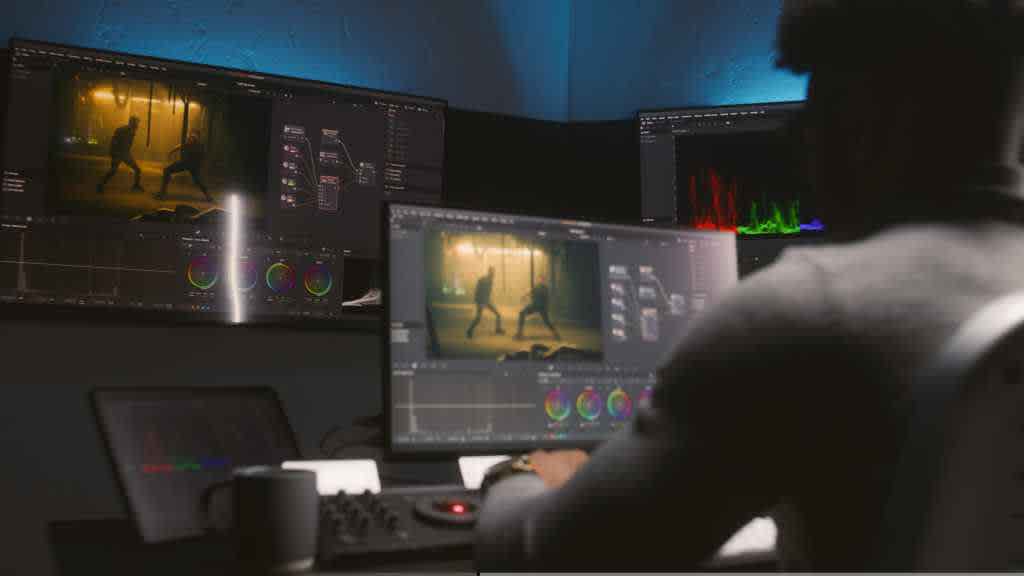
Artistic intent textures raw footage with the colour, contrast and motion we consider 'cinematic'. Credit: Frame Stock Footage/Shutterstock.com
Bond goes on: “SXRD displays feature fast response times that reduce motion blur, making them ideal for fast-paced content, and they are compatible with HDR content to enrich the viewing experience. They also support contrast ratios often exceeding 1,000,000:1, which allows for deep blacks and vibrant colours.”
Cinematic purism
From silent movies through to film noir, deep blacks have remained intrinsic to the emotional power of cinema. True blacks in projection create a higher dynamic range (the distance between the darkest and brightest point in the image) to support human vision, which uses darkness to sculpt light and space.
“Deep black is a holdover from the days when plasma TVs were introduced,” relates Bishop. He refers to how cinema blacks, by contrast, are limited by the projector's technology and by ambient light reflected from the screen and walls, which together define the black floor for projection.
Meanwhile, Epson’s “strong optical heritage has a huge influence on how it develops its projection technology”, according to White. The company developed its own lens systems and light engines first in printing. Specifically, its projectors house a proprietary 3LCD optical engine which uses liquid-crystal panels for red, green and blue instead of a single chip with a colour wheel (as in DLP). Its continuous light transmission parallels that of photochemical film, portraying depth with dynamic iris control and tonal gradation.
Bond also addresses the importance of the cinematic art form in Sony’s product development: “Our Lens to Living Room story leverages cinematic expertise from the Sony Pictures studios and professional film equipment in our portfolios. Our home projectors perform consistent picture quality adjustment and signal processing to reproduce the gradation and colour with creator’s intent.
“This is achieved by designing the basic picture quality parameters of the projector with the same targets for White Balance/Gamma/Colour as the industry-standard Sony BVM-HX3110 Master grading monitor.
Redefining the big screen
“We’re seeing cinema rooms used for more than just movies now. The growth of multimedia rooms and gaming via projectors are taking a traditionally immersive experience into new applications. Sony’s relationship with BRAVIA TVs, PlayStation gaming and Sony Pictures is instrumental to its future development.”
The Sony BRAVIA 7, 8 and 9 projectors support 4K at 120Hz, along with Auto Low Latency Mode. Bond adds: “We can also lean on the gaming expertise of Playstation to understand how to deliver an enriched gaming experience on the big screen by including features such as HDMI 2.1 inputs and a low lag for intuitive gaming.”
Bond touches on the home entertainment ecosystems shaping today’s installations, driving the market’s versatile, advanced integration. “Our BRAVIA TVs are engineered towards our professional moviemaking values,” he says. “We want to faithfully reproduce the creators’ intent from studio to home, whether it’s on a BRAVIA projector or TV.
“By unifying home cinema projectors, TVs, soundbars and other home audio technologies under a single brand, Sony aims for customers to have a one-stop destination to enjoy that ultimate cinematic experience.”
Final thoughts
As immersive visuals evolve in the connected home, media beyond the movies is becoming sharper on our senses and giving rise to bold new expectations of the luxury entertainment space. Brighter projection levels are unlocking new environments as well as nuances in content, while HDR is rolling out artistic movie delivery to more screens than ever before. If artistic intent influences our perceptions of quality, we may conclude that engineering metrics and professional standards crystallise the cinematic image we know and love.
Main image credit: Redmixx/Shutterstock.com