As we reflect on market trends at this year’s close, one product category stands out – and it’s almost as old as our industry itself. Let’s talk two-channel audio products, Michael Heiss says.
Two-channel audio products have taken many forms over the years: standalone preamps, amplifiers, receivers, tuners and integrated amps. Their prices have shifted from low to moderate to crazy high. But between it all, they have elicited constant interest from brands, dealers and the clients who enjoy them in their homes.
The topic of the day here is stereo, two-channel products. One might say they’re where true consumer audio started in the hi-fi days – and they’re also just as integral to its future. But before we chart that path, first we must take a step back and look at what has changed in this space, namely the growth and dominance of digital sources.
DAB+
Let’s start with good old-fashioned radio. After all, this is still an important way that many listen to music and news, especially for emergencies. But radio is undergoing a significant technological shift. Its evolution from AM to FM stereo, in many ways, mirrors television: things moved from 405- or 819-line black-and-white transmissions, depending where you were, to 625-line, colour, Phase Alternating Line (PAL) colour. Then, just as radio later went digital (DAB, internet radio), television eventually followed with DVB and streaming.
Taking the place of FM is DAB+, a digital broadcast format that delivers CD-quality sound with less interference and, in many cases, wider coverage. In short, for those who still want terrestrial radio (over-the-air broadcasts via ground-based transmitters) as part of their two-channel system, DAB+ represents the modern solution. A quick note for readers in the United States: HD Radio serves a similar role to DAB+ domestically. While it’s widely used in vehicles, it hasn’t had the same impact in home audio systems. That said, I’m a strong supporter of HD Radio – I use three receivers at home specifically for accessing its extra HD subchannels with improved clarity.
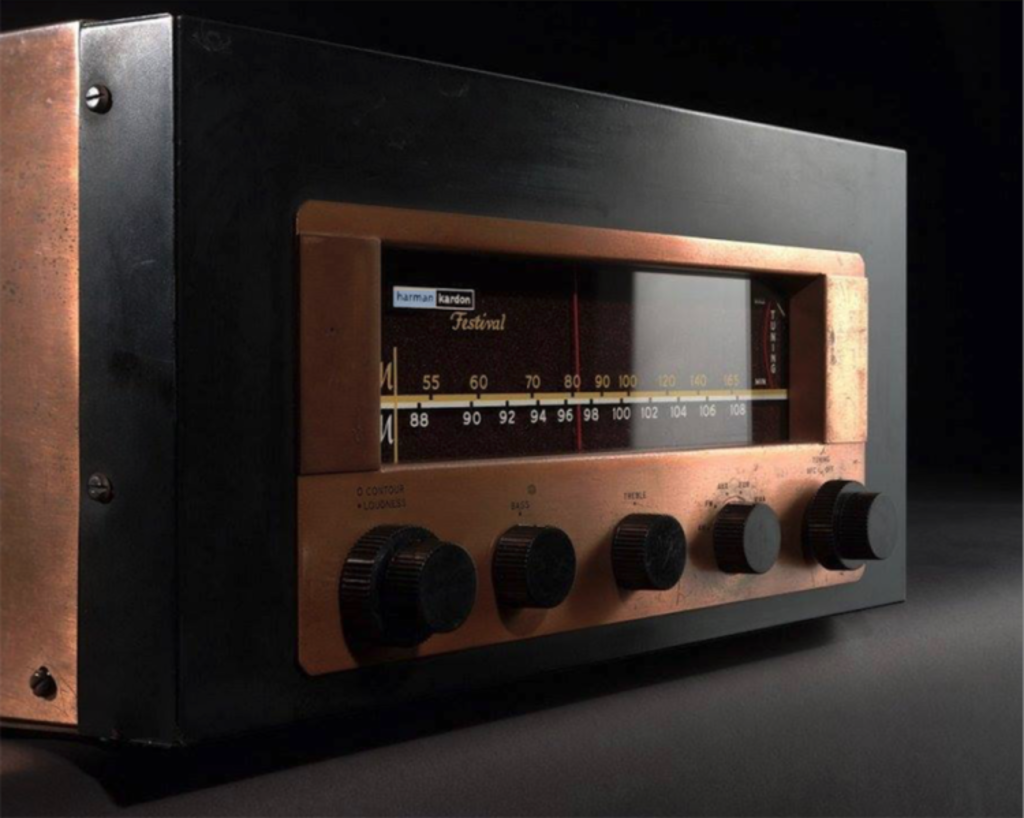
Harman Kardon’s Festival D-1000 is generally regarded as the first audio receiver product. Things have come a long way in the 70+ years since its introduction in 1954. Credit: Harman Luxury.
Streaming
Live audio broadcasts are still important, but today they’re increasingly accessed through streaming. Often, that means listening to a station’s online stream; this is the ideal solution when you’re out of range of its terrestrial signal, whether via a website or an app. That’s exactly what I did while overseas at ISE this year, tuning in to my local Los Angeles news stations. It’s also how many expats keep up with news and sports from home. Depending on where you are, popular platforms for this include TuneIn, Global Player, radio.net, myTuner Radio and Radio Garden.
Here’s where things get interesting. If, beyond radio, you want all the functionality of a traditional stereo receiver – features like bass and treble controls, loudness compensation, multiple analogue and digital inputs and outputs, a phono preamp, and of course, a built-in amplifier – then you’re looking at what’s now called a streaming receiver. If you prefer to use your existing amplifier, the equivalent device without the amp stage is known as a streaming preamp.
Now the fun begins. Replacing a traditional tuner with streaming opens up a world of options, but it also calls for a bit of planning ahead. There are numerous streaming modules available, each with its own pros and cons. Add to that the differences in how each brand integrates and customises these subsystems, and it’s clear that some research is in order.
Start by identifying which streaming services you need. Does the unit include a colour display that can be navigated via a remote or mobile app, much like a smart TV? That setup makes operation straightforward, but adds to the cost. Keep in mind, these are two-channel audio components, so a video output or on-screen menu is unlikely. Alternatively, a simpler two-line display might be perfectly adequate for up-close use, otherwise it’s harder to read from across the room. Some budget models may have no display at all, relying entirely on an app running on your phone or tablet.
Finally, pay attention to how you select inputs, whether between streaming and analogue or digital sources. The control interface is every bit as important as the number and type of inputs available.

A colour front panel display, shown on this Arcam SA45 streaming integrated amplifier, lets the listener see cover art alongside source selection and other functions.
Along those lines, you’d be wise to look at other input requirements. Does a product have Apple AirPlay? Don’t assume a product does. Similarly, is there a requirement for Chromecast to stream audio? The same goes for an HDMI input.
In a full AV receiver or surround processor, you’d typically want eARC for full bitstream connectivity, ensuring proper support for Dolby Atmos and DTS:X from a smart TV. Focusing on two-channel audio though, you only need standard ARC, which is perfectly sufficient. The same logic applies to Bluetooth.
Ideally, all your desired streaming services will be available natively within the product or through its companion app, possibly accessed via ARC from a TV. However, there will be times when you want to stream content directly from a phone or tablet, which is where Bluetooth becomes important. Be sure to confirm whether users are on Apple or Android devices; if it’s the latter, some phones support AptX for higher-quality Bluetooth audio, but not all streaming products do. On the Bluetooth output side, consider whether there’s a need for Auracast, particularly if multiple listeners will be using wireless headphones in the same room.
Connectivity is another key area to check. Determine whether single-band Wi-Fi will meet your needs, or if you’d benefit from dual-band or even Wi-Fi 6E/7 for 6GHz capability. And don’t overlook wired Ethernet when the installation allows for it.
Control
In the good old days of stereo receivers and integrated amps, a standard remote was good enough to control a two-channel product, but those days are now long gone. An app may be enough, but what about integration with control systems such as Crestron, Savant and Josh ai?
The same goes for native voice control. Can the product you want to specify respond to commands from Amazon Alexa products? How about Google Assistant products? Does the item you are looking for only respond, which requires a separate smart speaker, or are there built-in mics so the user may talk directly to the product? Where there are other streamers or smart speakers in the home, is there a need to talk to products comprising an ecosystem? That may limit your choices, but it’s important.
Back again to the old days: simple bass, treble and loudness were all you would expect of any respectable integrated amp or two-channel receiver. But now, the bar has shifted with the advent of sophisticated room control systems in AVRs and surround processors. Choices might be as simple as analogue bass management, before ramping up to 10-band EQ/PEQ where your expertise might be key. At the top of the list are self-measurement systems, famously Dirac Room Correction. That will place the product at the top of the price sheet; but offering it when the client recognises the value will put you at the top of their list when the bids are considered and winner chosen.
Sound quality
Some things do remain the same, but with time we’re seeing that digital products and their corresponding sources need to be assessed. A good example is the amplifier section, if the device has one; remember some of these streamers are the modern-day equivalent of a fully integrated amp, while others are akin to a tuner/preamp only.
Here, digital Class D amps have become the go-to technology. Once they got sneers, but now they’re often equal in sonic quality to conventional analogue A/B amp designs. However, don’t rely just on reputation and reviews: read the specs carefully and consider the speaker loads, as well as possibly auditioning the product. Some Class D amps are good, others not so much. You don’t want to find out how it sounds after the installation!
The same goes for the DACs, a critical part of the digital signal chain. Don’t make the decision based just on the DAC manufacturer. The best brands like ESS, AKM and others have different levels of quality. Here, too, read the specs carefully for SNR and more. And be prepared to explain what “dual-mono” DAC designs bring for higher models other than a higher price.
Yes, for two-channel products much has changed – while the end goal of great sound from a variety of sources remains the same. Apply your knowledge with an understanding of what has and will continue to change in this product category, and you’ll not only deliver that music for your customers, you’ll deliver increased profitability and additional client referrals, as well.
It’s fair to say 2025 has been an interesting year on many counts, both in our industry and for the world at large. I hope this has been a good year for all and my wishes to you for a happy, prosperous, healthy, and above all peaceful new year ahead. We’ll see you in 2026.
AUTHOR'S NOTE: Some of the technologies, formats, brands, products and products mentioned may not be available yet or sold in your country or region. Always please check with the manufacturers and service providers for availability before specifying.
Main image credit: mailcaroline/Shutterstock.com