As a wave of new display technologies hit the market, this overview from Michael Heiss helps decode the jargon for system designers and clients.
With CES and ISE 2026 wrapped ahead of NAB, Display Week and InfoComm, this seems a good time to review the display technology landscape. Perhaps even more so than usual, as this year’s initial round of trade shows revealed more interesting variants than those seen in recent years.
Combine that with the increased coverage of those new technologies in the popular press, and it’s a good bet your prospects will be asking about what they are and why you might be recommending one over the other. To maintain your place as the authority on these things, you need to be able to answer quickly and confidently. Fear not, dear reader, as this is where we can help.
Many of these display technologies use similar sets of letters in their acronyms to confuse even the most dedicated staff members, as well as the public. To understand why, it helps to step back. Early on, the landscape was simple: CRTs defined both direct-view sets and projectors. As plasma rose and then faded, LCD took over as the dominant flat-panel technology. Then came LED backlights, MiniLED, MicroLED, dvLED and OLED - each adding performance, but also more terminology.
Backlight basics
So, we’ve established today’s flat panel displays are described in alphabet soup. First, the basics and a bit of a refresher: LCD, or Liquid Crystal Display, is the layer that modulates light. Whether or not ‘LCD’ appears in the product name, if the picture depends on a backlight, you’re looking at an LCD-based display.
"Whether or not ‘LCD’ appears in the product name, if the picture depends on a backlight, you’re looking at an LCD-based display."
Then there is the BLU, or Back Light Unit. LCDs require a separate backlight because they’re not self-emissive (where each pixel produces its own light), and the BLU provides this light source. Early flat-panel displays used CCFL fluorescent tubes as the backlight, but these were replaced by LED backlighting in the 2000s. Manufacturers first adopted edge-lit designs, incorporating LEDs along the panel’s perimeter with a light guide spreading the illumination across the screen. And more recently, LEDs have been placed directly behind the panel.
This is where years of marketing muddied the waters. Manufacturers began calling LCD TVs with LED backlights ‘LED TVs’, even though the image is still created by an LCD panel. Unless you’re choosing OLED or dvLED, you’re still buying an LCD TV, just with a more advanced light source.
Enter RGB and Micro-RGB backlights
Here’s the key: dvLED displays create the image with the LEDs themselves, while RGB LED backlights still shine through an LCD layer. That’s where the fun really starts. You’ve come across micro-LED display, so called because the LEDs used as the light source are indeed microscopic. When used in direct view applications, be it for retail, large venues or even cinema-grade home theatres, these are discreet RGB LEDs mounted to modules that are, in turn, tiled together to create the final screen size and aspect ratio. Because these displays are self-emissive, there’s no LCD panel involved; this is why they’re classed as dvLED.
When ‘Micro’ really means Micro
Think of MiniLEDs as “small” and MicroLEDs as “very small” - tiny enough to enable extremely precise dimming control. The use of discrete red, green and blue (RGB) LED elements as an LCD backlight has generated significant buzz at recent trade shows. Because these LEDs produce colour directly at the light source, they can achieve higher brightness, greater colour purity and less reliance on filters or quantum-dot layers compared with white- or blue-LED systems. So if the product still uses an LCD panel, it’s a backlight technology, no matter how impressive the “Micro” or “RGB” branding may sound.
Although the approach may seem new, Sony introduced a full-array RGB LED backlight as early as 2004 with its Qualia 005 LCD TV. At the time, however, the technology was costly and soon overtaken by more affordable single-colour LED backlighting. Clearly times have changed.
"If the product still uses an LCD panel, it’s a backlight technology, no matter how impressive the “Micro” or “RGB” branding may sound."
We’re seeing RGB-backlit LCD models from several major brands entering the market. Be aware, however, that naming conventions differ. If a model name uses ‘mini-RGB’ or ‘micro-RGB’, it still refers to an LCD television using an RGB LED backlight, not a self-emissive direct-view LED display.
In general, ‘micro’ LEDs (typically <100 microns) enable finer dimming control, higher brightness and potentially better energy efficiency than ‘mini’ LEDs (often 100–200 microns), though definitions vary by manufacturer. Either way, RGB LED backlights can offer significantly improved colour purity and wider colour volume, with some manufacturers claiming coverage approaching the BT.2020 colour space.
To simplify the naming: Samsung’s Micro RGB and LG’s Micro RGB Evo both use Micro-class RGB LEDs. Hisense’s RGB models and TCL’s upcoming Mini-RGB sets, including the RM9L, use Mini-class LEDs. Sony has demonstrated its own backlight technology but has not yet finalised which models will ship this year.
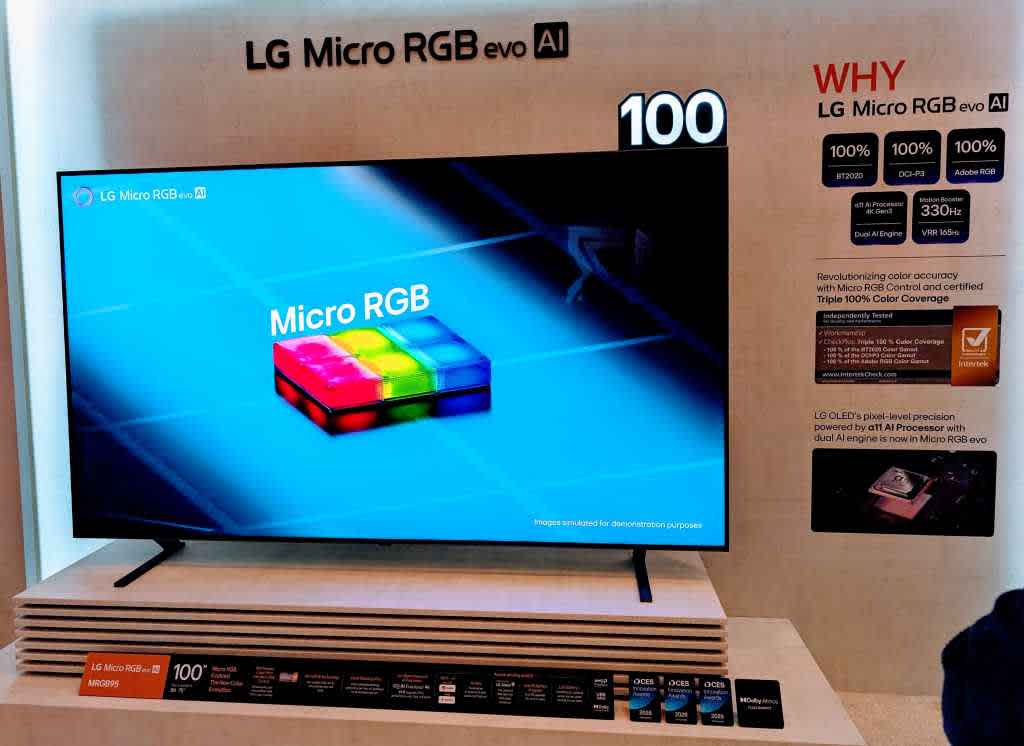
LG’s explanation of the benefits of their Micro RGB technology at a private preview during CES.
Four-colour backlights
However, as the late-night TV shopping adverts say “wait, there’s more!”, Hisense is pushing the idea further in its flagship 116UXS, adding a fourth, cyan LED to the RGB Mini-LED backlight. The company says this ‘RGB MiniLED Evo’ architecture improves colour accuracy and extends gamut coverage. Its 163MX, however, is a different beast; this one is a true MicroLED display with self-emissive RGBY pixels and no LCD layer.
To avoid confusion, dvLED displays such as Samsung’s The Wall are true self-emissive LED systems and not LCDs with LED backlights. In product descriptions, dvLED models are often described using terms like RGB LED modules, whereas LCD sets typically use phrasing such as LED or Mini-LED backlight. This helps distinguish self-emissive dvLED products from LCD-based ones.
Evolving standard mini-LED
Ready for some additional alphabet soup? While RGB-based Mini-LED and Micro-LED backlights were all the rage at CES and ISE, conventional white LED Mini LED technology has continued to advance. Major brands including LG (QNED), Hisense (U7), Samsung and Sony (Bravia lines), TCL (QM series) and others have refined their Mini-LED backlights with more precise local dimming, improved quantum-dot filtering and more powerful processing at a lower price than RGB micro- and mini-LED sets.
Different path to colour accuracy
TCL’s new SQD-Mini LED X11L series illustrates how far non-RGB backlit LCDs have come. TCL claims up to 10,000 nits of peak HDR brightness, approximately 20,000 local dimming zones (depending on size), and full BT.2020 colour coverage.
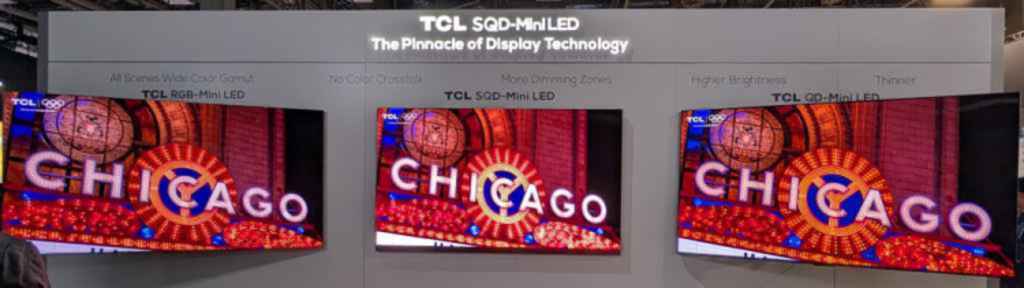
TCL’s CES stand display gave attendees a rare opportunity to see three different approaches to LED backlight technologies for LCD displays.
The performance is driven by TCL’s ‘Super Quantum Dot’ architecture and an UltraColour Filter. In private demos at CES, the SQD models compared impressively against TCL’s own RGB Mini-LED and standard Mini-LED models, a sentiment echoed by other reporters there on the ground.
OLED leaps in 2026
Despite the momentum behind advanced Mini-LED backlights, OLED remains unmatched in contrast and blacks thanks to its pixel-level light control. Historically limited by brightness, OLED is now closing that gap: LG Display’s new Tandem WOLED panels are rated up to 4,500 nits peak brightness, and Samsung’s 2026 QD-OLED Penta Tandem design similarly boosts luminance and efficiency.
For gaming and PC displays, LG’s adoption of True RGB-Stripe OLED panels and ultra-high refresh rates further strengthens OLED’s position across multiple categories.
Innovation beyond TVs
On the topic of display technology, there is one other early year trade show of interest; MWC, held a month after ISE, focuses on mobile tech but the advances shown there increasingly mirror what we’re seeing in TVs and monitors. TCL’s Super Pixel and NXTPAPER demos highlighted how improvements in backlights, filtering and contrast are making their way into tablets and handheld displays.
What all this means
The first quarter of 2026 will be noted for some significant advancements in video display technology – not just as prototype demonstrations, but as actual products that, by the time you are reading this, will possibly be available to spec into jobs for near-term delivery. The good news is there are demonstrable improvements in brightness, colour accuracy, dimming precision and panel efficiency across categories. However, the downside is the increasingly tangled branding landscape, where similar-sounding names can describe fundamentally different technologies.
"The downside is the increasingly tangled branding landscape, where similar-sounding names can describe fundamentally different technologies."
THAT can be a barrier to understanding when you are inevitably asked why you specify one set over another. But fear not; this treatise, along with our continuing coverage, are here to demystify the jargon. Remember, with the right technical context, it becomes far easier to explain why one display type may suit a project better than another.
AUTHOR'S NOTE: Some of the technologies, formats, brands, and products mentioned may not be available yet or sold in your country or region. Always please check with the manufacturers and service providers for availability before specifying.
Main image credit to Natalya Chernyak/Shutterstock.com