The past quarter has seen innovation continue at pace, with a focus on continuity between residential design and delivery. We dig behind the product launches to find out more.
After ISE in February, it’s fair to say the past quarter has reinforced just how far integration has come in domestic spaces. Fast, fluid and often imperceptible, it’s now deeply embedded in real-world architecture and AI-enhanced workflows.
Manufacturers are prioritising installer-friendly engineering over feature overload, while spatial considerations are influencing product form from the outset. And on a wider level, the boundary between digital and physical experience is rapidly receding.
At HiddenWires, we’ve been examining the market to highlight the industry’s core principles in 2026: simplified delivery, intelligent integration and cohesive design. Let’s take a closer look at each one.
Simplified delivery
Beginning with the move toward streamlined integration, manufacturers are working to reduce friction for installers by turning their attention toward complex residential projects. As a result, we’re seeing a surge of innovation around scalable yet pro-grade performance in the home.
Sonos’ latest amplifier, for example, represents continuity between integrator and end-user experience: launched in January, it introduces a new manual sound optimisation tool that gives integrators control over elements like ten-band parametric EQ, gain, width control and delay offset. These tools look to refine sound for speaker placement and room geometry, while app setting ‘Optimise Sonos Speakers’ delivers detailed DSP profiles for Sonos Architectural speakers.
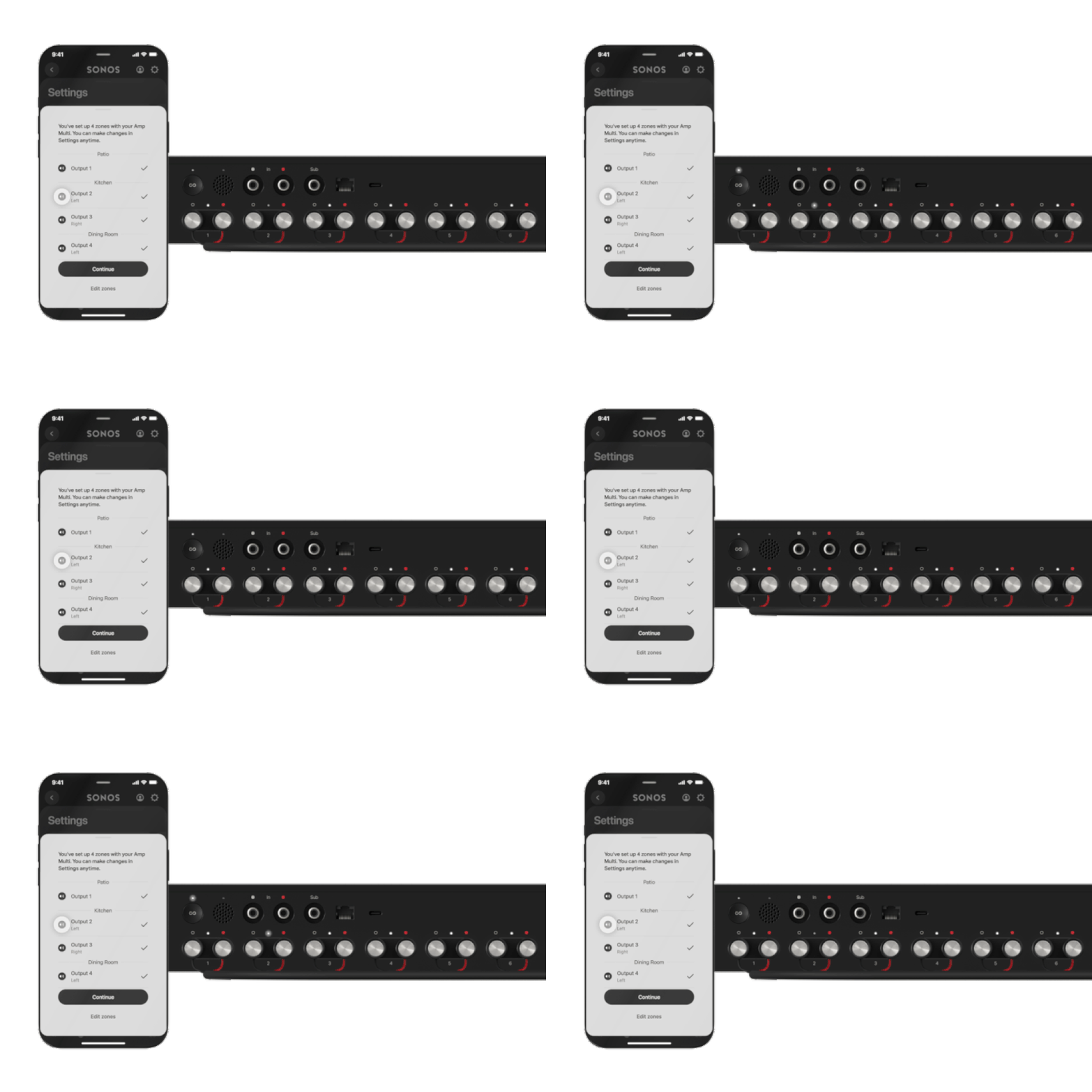
Source: Sonos Newsroom
With eight amplified outputs and four configurable zones, the Amp Multi takes cues from professional workflows to support usability from installation through to delivery. It’s worth noting that distributors like ADI are also closing this gap between commercial and residential application.
Similarly, network-first platforms such as Crestron’s DM NAX Intelligent Audio reflect a maturing approach to scalable audio infrastructure. Auto-discovery, PoE endpoints and standards-based interoperability demonstrate how the manufacturer is one of many increasingly positioning themselves as partners in the delivery of tech-enhanced homes.
Intelligent integration
As home control systems expand in both scale and capability, entertainment is evolving in the same direction. At ISE, AVPro Edge showcased its Hyperion home theatre lineup to start conversations about room-centric immersion – what it calls the Single Room Experience (SRE). Think of this as a destination for cinema-level performance without dominating the surrounding architecture, as a dedicated room would.
This approach reflects broader changes in content consumption; as audiences become more accustomed to highly cinematic programming at home, expectations around playback quality naturally build.
Hyperion offers reference-level video processing and sound to lead this charge toward cinematically capable rooms, simultaneously rooted in the thick of daily life.
As audiences become more accustomed to highly cinematic programming at home, expectations around playback quality naturally build.
And, moving from buzzword to infrastructure, it wouldn’t be right to leave AI out of the discussion. Platforms like D-Tools are embedding it in quoting, documentation and financial oversight to consolidate moving projects. These tools are most critical in a sector marked by lengthy timelines, shifting client expectations and, of course, the emotional complexity of home design.
Cohesive design
Invisible loudspeakers continue to form an interesting talking point, appearing to be widely misunderstood as a compromise rather than cornerstone of residential integration. At ISE, Stealth Acoustics highlighted how increasingly thin materials and refined installation techniques can effectively erase speakers from walls, ceilings and architectural surfaces. By demonstrating just how clean and stylish invisible audio can be, Stealth Acoustics made clear how this approach can enhance rather than interrupt a room’s aesthetic. With this in mind, it wouldn’t be a surprise if multipurpose architectural speakers began to emerge, integrating with lighting elements, decorative panels or signage.
It wouldn’t be a surprise if multipurpose architectural speakers began to emerge, integrating with lighting elements, decorative panels or signage.
Sticking with the theme, the Luxury Immersion Theatre at ISE showcased how immersive audio is evolving to meet new architectural demands. The space brought together the expertise of Barco Residential, ASCENDO Immersive Audio, StormAudio, PrimeTheatre and Technology Integration Partners (TIP) to optimise performance within the constraints of a trade show floor. On a visual level, Barco’s Runar LED video wall delivered native DCI 4K resolution and is currently on track for professional DCI certification. And ASCENDO’s point-source loudspeakers and infrasonic subwoofers were arranged around the perimeter to optimise performance, an approach devised for installations when placement behind LED walls isn’t possible.
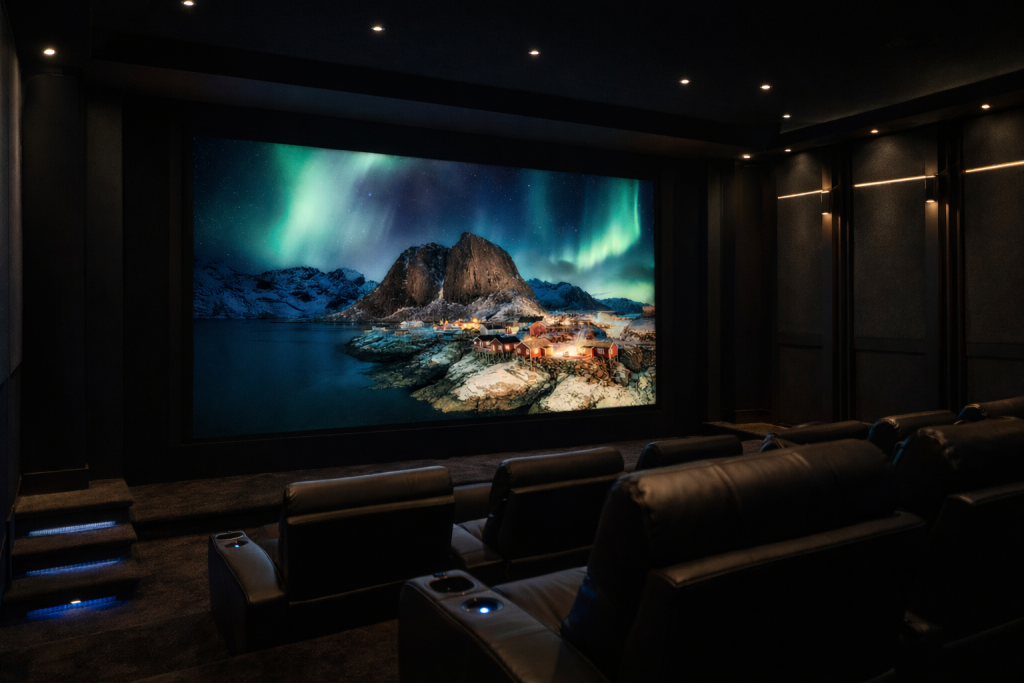
Barco Residential's Runar Home Theatre. Credit: Barco Residential
Meanwhile, listening suites from brands such as Bowers & Wilkins demonstrated how air-filling sound can replicate the intimacy of personal listening in shared spaces through the 801 D4 Abbey Road Limited Edition loudspeakers, in partnership with Marantz Series 10 electronics.
New lighting launches also attest to the fact that architecture and technology are no longer separate disciplines. With their new Intelligent Lighting portfolio, brands such as Lutron, Orluna and Ketra are reshaping illumination as a design tool rather than a technical layer. Fixtures are slimmer, materials more considered, and application softened around lived design.
Similarly, interfaces that combine tactile luxury with advanced intelligence are gaining momentum across the market. While manufacturers like Control4 recently moved into this offering with their Lux Keypads, Moorgen brought its meticulously crafted interfaces to a dedicated UK showroom back in January. Its showcase highlighted the expressive and visual possibilities of smart home technology.

And while touchscreens still play an important strategic role, they are no longer the sole marker of sophistication; instead, the industry is rediscovering our attachment to inanimate objects, uniquely smart with today’s advancements. Waterfall Audio emphasised this kind of material longevity at its ISE booth, its speakers drawing inspiration from watches, automotive and aviation markets to feel culturally and physically enduring.
In short, the sector is now prioritising pro-grade performance, practical delivery for installers and architectural fit to make great sound and image experiences native to the living space.
Main image credit: FabrikaSimf/Shutterstock.com