HiddenWires speaks to audio specialists rethinking the science, limits and future of hidden speakers as installers navigate the invisible age.
Although favoured for its visual discretion in residential projects, invisible audio remains one of the most misunderstood categories in architectural sound. With no visible drivers, grilles or reference points once installed, its performance can feel either revelatory or disappointing – depending largely on installer influence.
At its best, invisible audio offers a transformative relationship between sound and architecture. But at its worst, it exposes the fragility of this relationship when surface materials and finishing trades are treated too casually. As manufacturers refine measurable install standards, the challenge has shifted from audio performance to reliable delivery.
Defining invisible audio
True invisible systems rely on exciter-based or Distributed Mode Loudspeaker (DML) technology, where sound is radiated through a flat surface rather than a cone and tweeter hidden behind plaster. These invisible speakers radiate sound across a much wider area than conventional loudspeakers (which conversely focus energy into defined listening angles). Their constant dispersion, approaching 180 degrees, creates a more homogeneous sound field as listeners move through a space. But that behaviour also means surfaces, materials and surrounding fixtures exert a strong influence over balance and output, making invisible audio more like a construction science.
Surfaces, materials and surrounding fixtures exert a strong influence over balance and output, making invisible audio more like a construction science.
Adrian Ickeringill, director of sales for EMEA at Sonance, explains: “An exciter-based speaker uses an exciter attached to something like glass or drywall, which then vibrates that material to creates sound. This approach introduces many variables: the type of material, how that material is attached to the wall structure, how well the exciter is attached to the material, and many other variables all come into play that can affect the sound quality.”
With a similar focus, Constantin Ranke from German specialist Cerasonar stresses that physical constraints can undermine audio integrity. “The point of invisible speakers is to hide advanced systems and maintain a clean living space,” the product designer explains. “But sound still depends on materials, placement and correct setup. Sometimes rattling or vibration only appears once the room is finished, often caused by surrounding accessories rather than the speaker itself.”
Materials and longevity
Cerasonar’s approach centralises its product development around longevity. Producing aluminium column speakers since 1999, the company transitioned into invisible audio over 15 years ago. Ranke says: “When we started developing invisible sound, we tested every material we thought was suitable. Sound quality comes first, but it also has to last. We focus specifically on panel thickness, surface mass and material stability over time.”
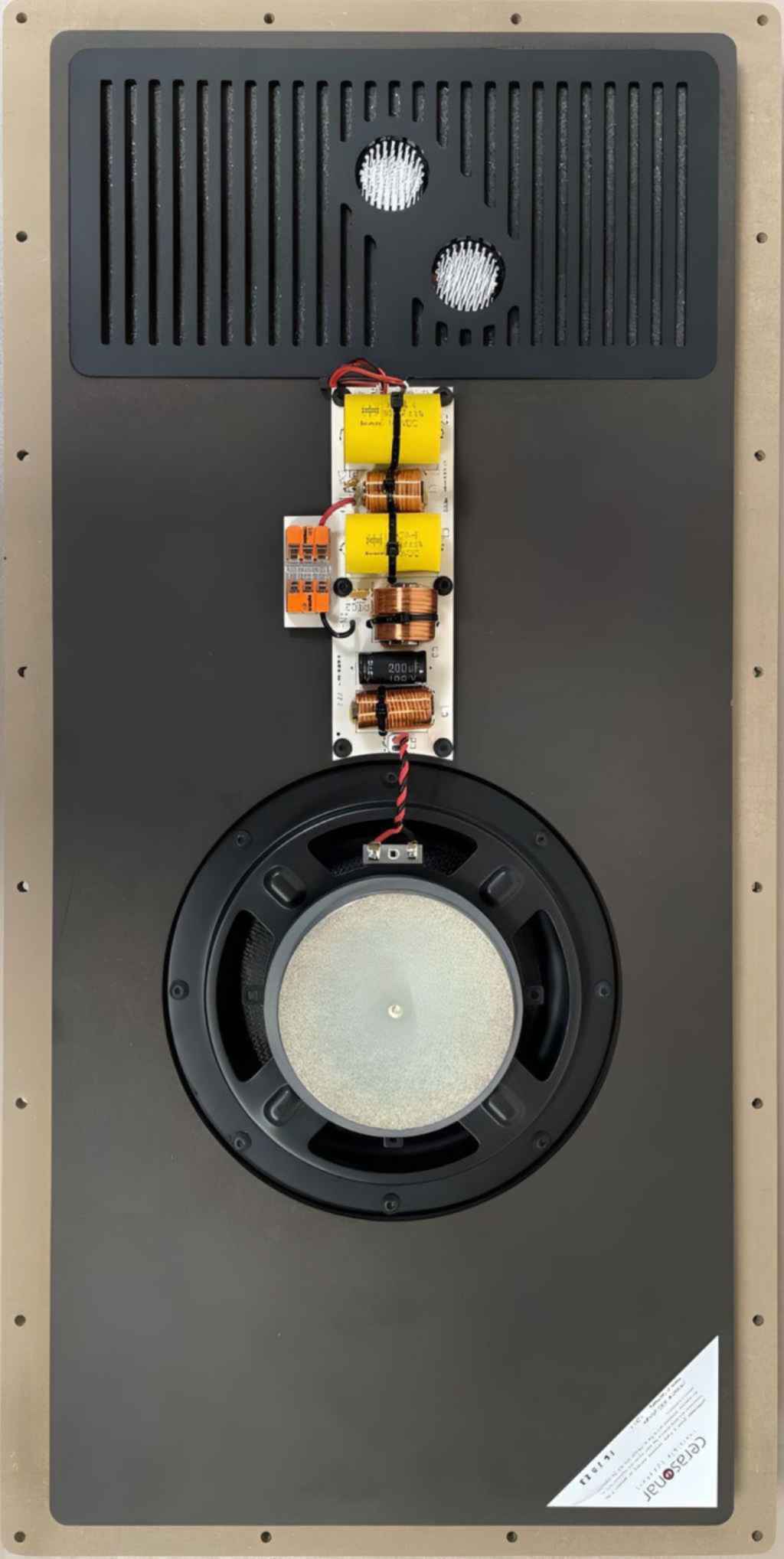
Larger, stiffer panels allow Cerasonar’s systems to transmit low frequencies more evenly than thinner alternatives, while thicker materials reduce the acoustic impact of paint or wallpaper applied during finishing. Additionally, integrated DSP presets and limiters aim to increase maximum sound pressure levels without compromising panel integrity. This is key to pushing invisible audio beyond background music into more demanding residential applications.
“Sound quality comes first, but it also has to last.”
“When we started, sound quality was good, but SPL wasn’t high enough for home cinema,” Ranke notes. “But today that’s no longer an issue, provided the system is designed correctly and supported by subwoofers and DSP.”
Moving the conversation forward, Ickeringill says invisible speakers can now compete with and even exceed the listening performance of visible speakers. “That's a meaningful shift from even five years ago,” he highlights. “The real commitment isn't to a product; it's to a process. These speakers need to be designed into the project from the start. Get that right, and the result is genuinely indistinguishable from a room that was never touched.”
He adds that system-wide coherence becomes “the governing principle” when designing invisible audio naturally into multiple rooms. “Across a whole home, you're managing acoustic continuity: how rooms relate to each other, how signal handoffs feel to the listener as they move through the house, and how material variation from room to room affects tonal character. Sound leakage between rooms is also a real design consideration at scale, which is why we offer a range of back box enclosures providing up to 20dB of isolation.”
“The real commitment isn't to a product; it's to a process. These speakers need to be designed into the project from the start. Get that right, and the result is genuinely indistinguishable from a room that was never touched.”
Installation as engineering
The promise of invisible audio quickly unravels when installation is treated routinely rather than structurally. Brian Azzano, VP at Stealth Acoustics, reframes the conversation away from disappearance and towards discipline.
“Our approach isn’t about simply hiding a conventional loudspeaker behind plaster,” he explains. “Performance depends on ultra-thin diaphragm materials – how energy is coupled into the surface, how that surface is framed and finished. In our hybrid designs, the plaster finish itself becomes part of the acoustic system.”
Stealth’s systems combine exciter motors for high-frequency energy with acoustically coupled low-frequency drivers, both working through a controlled air cavity. If plaster thickness or framing rigidity is misjudged, performance changes dramatically. For that reason, the company is prioritising installation education as much as product design.

Mark Cichowksi, director of business development at Stealth says: “We’re often trying to counter the perception that these systems are too difficult to put in through extensive integrator education. But if dealers follow the guides we provide and partner with a paint and drywall professional, that relationship typically accelerates to create a truly exceptional outcome for the end user. In addition, the broad dispersion allows for more flexible placement, with the sound seeming to follow people around the room.”
It makes sense, then, that manufacturers are emphasising early collaboration with installers to support unfolding projects. “When we work with a new installer, we often preprogramme systems in advance, label channels clearly or walk through setups together,” Ranke explains. “The critical point is always correct DSP configuration, which secures both sound quality and ongoing reliability.”
Where invisible audio works best
Broadly speaking, invisible audio delivers the most value when integrated from the outset. New builds and full renovations allow speakers, cabling and surface to be designed as one high-tech system. In these scenarios, invisible audio can outpace expectations particularly in open-plan living spaces where wide dispersion reduces the need for dense configurations.
“Invisible speakers can outperform traditional surround formats in certain applications, largely due to their wide and consistent dispersion,” says Azzano. “Conventional systems, particularly Dolby Atmos overhead channels, demand highly precise placement to achieve the intended effect. But invisible audio eases those constraints, giving installers far greater flexibility over speaker positioning without compromising immersion. The same advantage applies to surround, rear and side channels, widening the range of speaker locations and simplifying system design.”
“Invisible speakers can outperform traditional surround formats in certain applications, largely due to their wide and consistent dispersion."
It’s important to note that invisible audio struggles in projects that favour speed or concealment over nuances like surface depth or surrounding fixtures. Once sealed into architecture, errors become architectural rather than audio – with high correction and reputational costs.
Stealth says it avoids this dilemma by providing a placement template for installers to mount on the wall or ceiling, allowing framing to be adjusted before wallboard is installed. Once the wallboard is up, the installer removes the template and mounts the speaker before handing over to the finishing trades.
Ickeringill adds: “The design intent must be locked before walls close, because correction after the fact is essentially a demolition project. Where invisible speakers require the most engineering is in the low-frequency range; the mass of the plaster works against cone excursion, which is why pairing with a dedicated invisible or low-profile subwoofer matters for listeners who want full-range performance.”
As well as design intent, installation precision plays a major role in invisible audio performance. Depth Identification Sensing Calibration, or DISC, is Sonance’s Invisible Series measurement system. It uses a handheld magnetic depth gauge (DG 1) and embedded steel discs to quantify the thickness of plaster/drywall mud on an invisible speaker diaphragm before final finishes are applied.

“Without something objective, recommendations don't carry weight on a busy site,” Ickeringill points out. “DISC was developed specifically to close that gap: a measurable, repeatable read of topping compound depth that installers can verify before the surface is locked in.”
Designing sound into the future
Beyond walls and ceilings, manufacturers are exploring how sound can occupy furniture, sculptural forms and even outdoor spaces. Cerasonar’s concrete series responds to growing demand for garden and terrace audio in Europe, offering speakers that are physically present yet visually organic. Meanwhile, Original Equipment Manufacturer (OEM) projects integrating audio into furniture point to a future of structural as well as functional sound systems.
This move mirrors minimalist trends elsewhere in residential technology. But while motorised ‘conceal and reveal’ systems like hidden TVs remain popular, invisible audio sidesteps this mechanical complexity in favour of embedded use – an approach that could eventually extend into dual-purpose architectural surfaces or even haptic feedback.
Invisible audio depends on an unusually close collaboration between manufacturers and residential technology installers, rewarding deliberation over estimation at every stage of the process. When engineering protocols and installer workflows are treated as part of the same system, these speakers can deliver consistent performance long after initial installation. Their success is determined less by their technology alone and more by their execution, putting integrators at the centre of a system felt for all the right reasons.
Featured image: Shutterstock.AI